If you relate to the title above, especially the overthinking part, you are not alone. Overthinking from time to time is a normal part of being human, and there’s a plethora of reasons why. Tiredness, feeling stuck, a lack of control, along with regret and worry, are some of the reasons we fall into the spiral of stinking thinking. But as said, overthinking from time to time is normal, and most of us can catch it, set new intentions and place our attention on what’s helpful. The problems arise when you believe that you have no control and can’t help it. It’s as if the mind is in control, and all your intentions to be calm and present don’t get a look-in.
In this post, I am going to explain how overthinking catches and traps us before we realise it, and share helpful, evidence-based practices to help you break free from the overthinking habit. Plus, they are ridiculously simple and profoundly helpful!
What Causes Overthinking? Understanding the Mind-Body Loop
First, it’s all in the mind. Well, it all begins in the mind. The thoughts, beliefs and stories you’re telling yourself. Then, the thoughts cause tension in the body and drive the unpleasant emotions, such as anxiety and overwhelm. Queue the spiral loop that evokes more thoughts, and the cycle continues. Before you know it, you’re stuck in stinking thinking.
Here’s the good news: although you can’t stop your thoughts, you can change how you react and respond to them. You can take control of your mind; it just takes practice, and neuroscience proves that practice leads to profound change. Let me explain how profound this practice is:
The Supersonic Jet Analogy: Who’s Driving Your Mind?
Recently, I was boarding a flight home from France. As I walked toward the Aer Lingus aircraft, a thundering roar erupted. Everyone’s eyes were fixed on the supersonic jet speeding down the runway, liftoff and shoot to the sky perpendicular to the ground. It took about seven seconds! It was one of the most powerful machines I have ever witnessed. Now, imagine that supersonic jet had no pilot, no one in the driving seat. Imagine what could happen if a machine as powerful as our supersonic jet were left to its own devices. Ok, maybe it’s best not to overthink that one, but you get the idea and here’s my point:
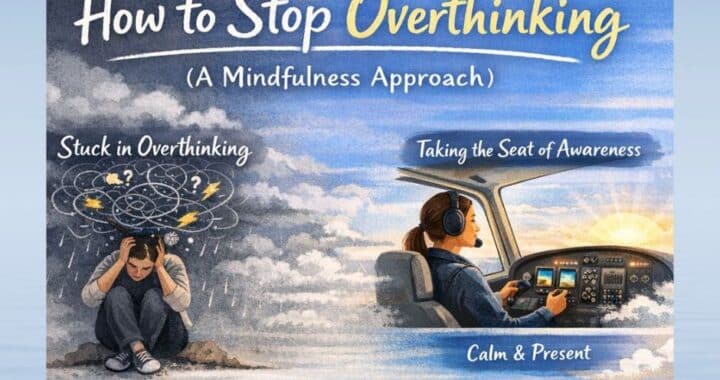
The mind is the same – it’s a powerful vehicle that drives our thoughts, affects our emotions, our body and what happens next. It can take us anywhere. When we set intentions for where we want to go, how we want to feel, and what actions will support us, we are like the pilot in that supersonic jet, intentionally taking the seat of awareness. However, a lack of awareness leads us to slip into overthinking, crashing into the landscapes of our mind, causing all kinds of unnecessary upset and debris.
Therefore, all you need to do is practice awareness.
“Well, Hilary why didn’t you just say so!” I hear you ask, followed by something like: “If only I’d known it was that easy, cheers for the heads up”, and yes, I hear your sarcasm without judgment.
But that’s the thing, it is that simple, but it’s not always easy. Practising awareness takes practice, and that’s where mindfulness comes in.
Let’s stay with our supersonic jet for a moment. If the engine is running and the machine is in gear, in the absence of the pilot, who’s driving it? Maybe autopilot is. But someone needs to programme the autopilot system with skill, intent and precision.
Relate the same concept to the mind. Who is driving the mind when we are overthinking? You guessed it: autopilot without a programme. Therefore, leaving the mind to its own devices enables it to drive itself into all sorts of difficult places – the past, the perceived future, and even places that will only ever exist in the mind. We call that worrying over something that may never happen. Yet the mind is just doing what it knows how to do: think to survive.
So, How Does Mindfulness Help Overthinking?
The problem is that we overthink, thinking we’re solving a problem, when in reality, we are just creating another one and getting stuck in the process.
Practising mindfulness is the same as the pilot taking the captain’s seat on our supersonic jet. The landscape stays the same; global events will unfold, oil prices will increase, AI will continue to grow, and people will behave as they do. Except when we sit in the driving seat of our mind, we stay present within the realms of what we can control, respond skilfully to what we can’t, and build the resilience to remain steady and grounded in our strength. We can see clearly, with healthier perspectives, engaging in what will support us on both the internal and external landscapes. In other words, mindfulness practice supports us in cultivating awareness of what’s unpleasant, allowing it to be, and placing our attention on helpful, practical, and realistic pathways toward skilful action.
A Simple Mindfulness Practice to Stop Overthinking (Step-by-Step)
Here is a simple yet profoundly helpful mindfulness practice you can do anywhere, anytime: whether you are lying awake at night, sitting at your desk, driving your car, or mopping the floors. Anytime overthinking kicks in, engage in the following practice:
-
Become present: Anchor Your Attention
Either place your attention on the breath or sense into the weight going down on whatever you are sitting or lying on. If standing or walking, sense into the feet on the floor and rest your attention there for a few moments. Slow down.
-
Practice Awareness: Notice Thoughts, Emotions and Sensations
Ask yourself: what thoughts are present right now? What am I thinking? Name the thoughts like the weather: stormy, calm, miserable or heavy. Simply notice what’s present.
Ask yourself: What emotions are present right now, and where are these emotions strongest in my body? Fear, angst, anxiety, worry, overwhelm. Simply naming the emotion enables you to create some space between you and the emotion – in this way, you have a hold of it as opposed to the emotion having a hold of you.
Thirdly, ask yourself? What’s present in my body? Is there tension in my shoulders, am I clenching my jaw, frowning, or something else? Relax and take a moment to breathe a little ease into the tension in the body. Notice how that feels. Take a moment and take your time.
-
Respond Skilfully: Choose Your Next Step with Intention
- Choose an intention that defines how you want to feel and aligns with your strength. Maybe your intention is to feel confident or strong, to call forth your resilience, or something else. Let your mind, body and emotions align with your intention.
- Ask yourself: Where is it helpful to place my attention right now? What will support me right now? Maybe it’s moving the body, talking to someone, or, if in bed, practising a body-scan meditation or something else. Perhaps it’s prayer or simply resting the attention on the breath.
- Personally, I think this one is the game changer: What attitude or spirit can I bring to this moment? Patience, trust, curiosity, acceptance, non-judgment, allowing or something else. Allow the attitude or spirit to fill your whole body and mind and notice the difference.
Effectively, what you are enabling during this mindfulness practice is space between you and whatever is present, allowing you to choose a skilful and helpful response while releasing you from overthinking.
The key is to practice the above and notice the difference. Effectively, you are like the pilot of your mind, taking the seat of awareness and responding skilfully.
It is most certain that nothing will change in the external landscape, but everything has changed because you have changed your relationship to it. Most of all, you have liberated yourself from overthinking and discovered the rich and fruitful landscapes beyond.

Finally, remember,
This life is meant to be a lived experience in the now, not the past or perceived future, right now. Each time you return to this moment, you take your seat of awareness, reconnecting with a deeper sense of calm, patience, and steadiness. From this place, something shifts, there is more space, more clarity, and a quiet freedom to meet life as it unfolds, with trust and ease.
Ready to Stop Overthinking and Feel More Calm and Grounded?
If you’re tired of feeling caught in your thoughts and want a calmer, clearer way of living, I can support you.
Through one-to-one mindfulness sessions, I’ll guide you to step out of overthinking, reconnect with your inner steadiness, and respond to life with more clarity and confidence.
This is not about fixing you. Rather it’s about helping you take your seat of awareness and learn practical, powerful skills you can return to every day.
Why not get in touch via WhatsApp or email to arrange a session.


